Pet ownership is one of the most reliably high-spend consumer categories there is, and it is under-served by software. The obstacle is not acquisition — pet owners download pet apps readily. It is retention. Most pet apps are a logging tool, and logging is a chore users abandon within two weeks unless the app gives something back.
The fix is to make the app answer questions rather than collect data. An owner does not want to record that their cat ate; they want to know whether the food they are buying is any good, whether the lump they just found matters, and whether their pet is the right weight. Build the features that answer those questions and the logging happens as a side effect, because now the data has a purpose.
A closer look at everyday pet care
Care tracking and a pet profile, shown in a local browser build of Yapzy.
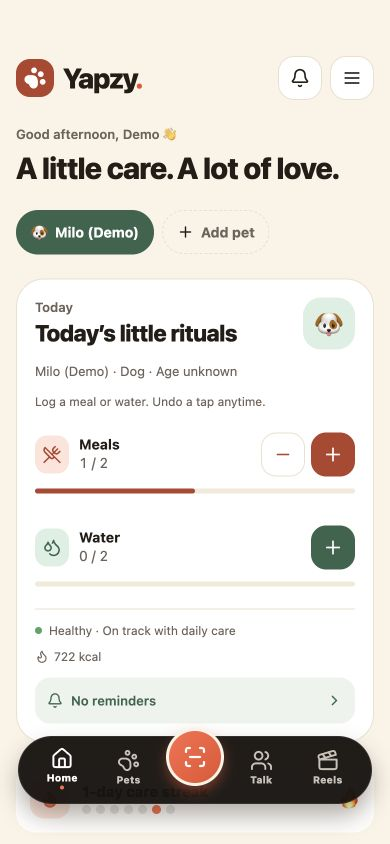
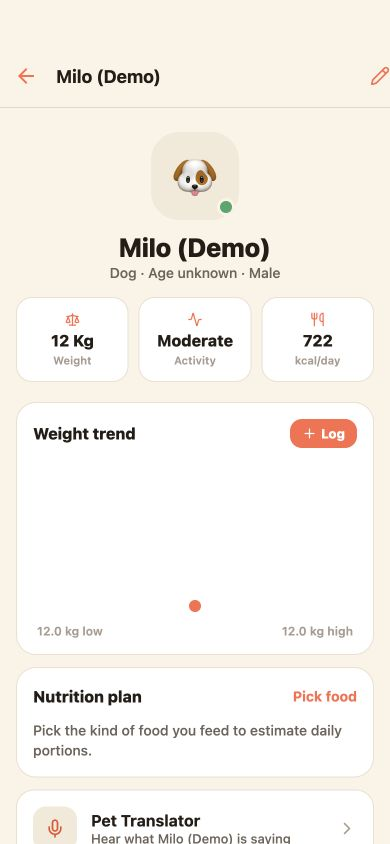
Browser preview · 3 October 2026. Fictional Demo/Milo data. Care labels and calorie estimates are interface examples, not veterinary assessments. AI, cloud sync and store release were not tested in this capture.
Browse screen captions and originals · Yapzy
Browser preview · 3 October 2026. Fictional Demo/Milo data. Care labels and calorie estimates are interface examples, not veterinary assessments. AI, cloud sync and store release were not tested in this capture.
AI is genuinely well-suited here, with limits. Image and text models handle the recurring questions in pet care well: reading a food label and flagging fillers and allergens, assessing visible symptoms across skin, eyes, ears, paws and coat, and estimating body condition from a photo. Yapzy ships exactly these three as its AI Scan tools. What matters as much as the capability is the framing — the app states plainly that this is vet-informed guidance and never a diagnosis. Those labels describe intended guidance; they are not evidence of clinical accuracy or a determination of regulatory status.
Multi-pet and multi-species support has to be in the data model from day one. Households commonly have more than one animal, and dogs, cats and birds have different care schedules, nutrition profiles, and risk factors. Retrofitting species-awareness into an app built for one dog is a rewrite. Build pets as first-class entities with species and life stage attached, and every downstream feature — reminders, nutrition targets, product matching — gets easier.
Reminders are the retention engine, and they are easy to get wrong. Feeding, walks, medication, and vaccination schedules are the reason an owner opens the app daily. But notification fatigue kills apps, so reminders have to be genuinely actionable, timed to the owner's routine rather than the server's clock, and easy to snooze without guilt. One well-timed medication reminder beats five generic nudges.
Commerce works in pet apps when it is matched rather than generic. An owner does not want a pet store; they want the right food for a four-year-old indoor Angora cat. Matching recommendations to the pet's species, age, weight and condition — and being transparent that you are doing so — converts far better than an untargeted catalogue, and it turns the profile data the owner already entered into something that visibly benefits them.
Community is the underrated retention feature. Pet owners want reassurance from other owners more than they want another dashboard. A feed where people share wins, ask questions, and compare notes gives the app a reason to be opened that has nothing to do with data entry, and it generates the content that makes the app worth returning to on days when nothing needs logging.
Records matter more than they seem. Vaccination history, weight over time, medication logs, and vet documents scattered across emails and paper are a real pain point, and an app that consolidates them into something exportable — a single PDF to hand a groomer, boarder, or new vet — creates switching costs the moment it is used once.
Brainbaby Labs built Yapzy, a pet health companion with AI symptom, food-label and body-condition checks, care reminders, a community feed, and species-matched product recommendations. If you are building in pet tech, get in touch.