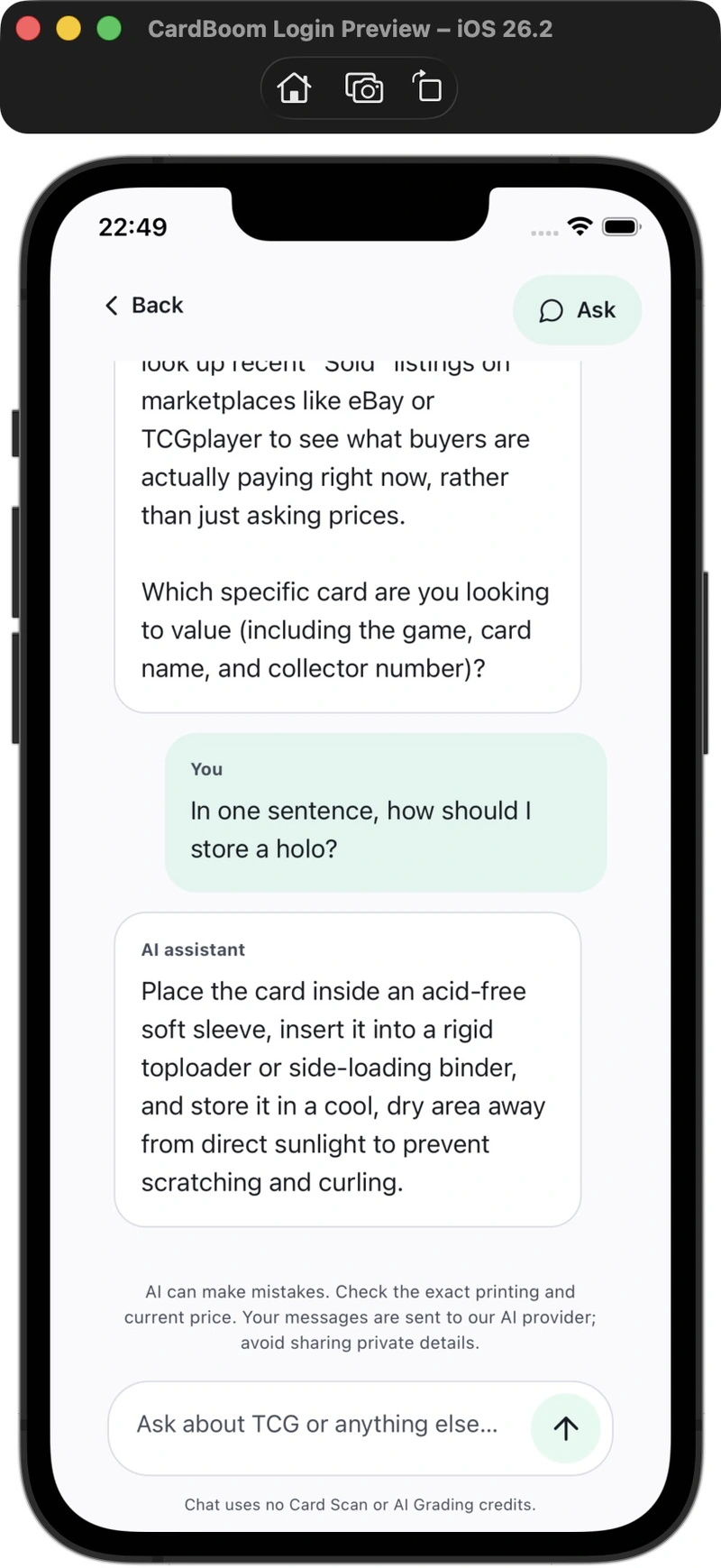
In Cardboom, a collector can open an assistant from the home screen and ask a follow-up without leaving the app. This recorded iOS test shows a question about storing a holo card and the actual response.
01
Start with the existing workflow
Choose a place users already visit. The observed assistant entry lives on Cardboom’s home screen.
02
Keep the result reviewable
The captured answer stays in the conversation. Users can inspect the guidance and ask a follow-up.
03
Separate advice from actions
This exchange is guidance. It does not buy, list or grade a card. Your acceptance plan should check those boundaries and provider failures separately.
Cardboom mobile assistant: recorded holo-card storage question and actual response
Recorded iOS release-simulator test, 1 October 2026. Internal-test evidence; not a claim of public store availability, answer accuracy or user outcomes. Original simulator window and app content preserved.
Browse screen captions and originals · Cardboom · AI
Recorded iOS release-simulator test, 1 October 2026. Internal-test evidence; not a claim of public store availability, answer accuracy or user outcomes. Original simulator window and app content preserved.
Almost every product roadmap in 2026 has an AI feature on it. Most of them ship as a chat box in a corner that nobody opens twice. The difference between AI that retains users and AI that becomes dead UI is rarely the model — it is whether the feature removes a specific piece of work the user was already doing.
Start from the friction, not the technology. In Lifepack, the AI earns its place because describing symptoms in plain language is genuinely faster than navigating a form, and scanning a meal is faster than logging it by hand. In Yapzy, scanning a food label answers a question the owner could not easily answer alone. In Cardboom, image recognition removes the worst part of selling a card, which is identifying and listing it. In every case the AI replaced a chore. That is the test to apply before writing any code.
Choose the model tier per task, not per app. Product teams default to the largest available model for everything and then panic at the bill. In practice most in-app AI work splits into three tiers: classification and extraction, which small fast models handle well; conversational and reasoning work, which needs a frontier model; and generation of long structured output, which sits in between. Routing each task to the cheapest model that clears your quality bar is the single largest cost lever you have, and it is usually a 5–10x difference.
Latency is a product decision. On mobile, anything over about two seconds without feedback reads as broken. Stream tokens so the user sees movement immediately. Run classification on-device where the model is small enough. Prefetch predictable calls before the user asks. And design a real loading state — a skeleton that reflects the shape of the answer beats a spinner, because it tells the user what is coming.
Budget for the cost curve before launch, not after. AI features have a per-use marginal cost, which is unfamiliar territory for teams used to fixed server bills. Model that cost against your actual usage distribution, not the average — a small share of power users will generate most of the spend. Cache aggressively, cap free-tier usage, and put the expensive capability behind a paid tier from day one. Retrofitting a paywall onto a feature users already get free is far harder than launching with the line drawn.
Plan for wrong answers as a first-class state. Models are confidently wrong sometimes, and your UI has to hold that. Show sources where they exist. Let users correct output and feed the correction back. Be explicit about what the feature is not — Yapzy's AI Scan tells the user plainly that it is guidance and never a diagnosis, which is both the honest framing and the one that keeps the product out of regulated territory it does not belong in.
Evaluate continuously or you are flying blind. Build a small golden set of real inputs with known-good outputs and run it on every model or prompt change. Log real usage, sample it, and grade it. Track refusal rate, latency percentiles, and cost per session next to your normal product metrics. Teams that skip evaluation discover regressions from user complaints, weeks late.
Finally, treat privacy as a design constraint rather than a policy page. Be explicit about what leaves the device, keep sensitive processing local when you can, avoid training on user data unless it has been genuinely opted into, and give users a way to delete their history. On mobile the store review process will ask, and users increasingly ask too.
Brainbaby Labs builds AI features into production apps — including our own, running on our in-house Baby 3X model. If you are planning AI in your product and want it to be more than a chat box, get in touch.
From planning to a useful conversation
Your software project brief template
Define the first release before comparing proposals. Write what you know, leave open questions visible, then download a brief you can edit and share with a development team.
Review your brief
Brainbaby Labs — Your software project brief template

Main project type: AI features with evaluation and human review

1. Outcome
What problem should improve, and how will you recognise improvement?
To be discussed

2. Users and access
Who uses it? Which roles, devices or accessibility needs matter?
To be discussed

3. One complete first-release journey
From the first action to a useful result, including waiting and recovery.
To be discussed

4. Existing systems and integrations
What already exists? Who owns access? What still needs investigation?
To be discussed

5. Release and budget constraints
Target window, platforms, spending limit and known dependencies.
To be discussed

6. Acceptance and ownership
What demonstration proves completion? Who owns accounts, code and operations?
To be discussed

Questions to resolve with the development team
- Agree deliverables, exclusions and acceptance criteria.
- Separate build costs from hosting, provider usage and support.
- Record ownership, handover and responsibilities after launch.

Discuss this project carries your brief to the form in this tab, using browser storage for up to 30 minutes. Review and submit it yourself; nothing is sent yet. Use non-sensitive examples. Download a copy before leaving.
Discuss this project carries your brief to the form in this tab, using browser storage for up to 30 minutes. Review and submit it yourself; nothing is sent yet. Use non-sensitive examples. Download a copy before leaving.